Minggu, 22 Juni 2014

Huckleberry Roasters Blue Orchid Blend- A Great Light Roast

Huckleberry Roasters Reivew

A small package arrived at my house a few days before Father's Day.  My wife scooped it up and it disappeared.  I suspected that this could be a Father's Day present, but I couldn't be certain.  The package was the size and shape of a small book, and my wife gets a book once or twice per month.


Huckleberry Roasters
Image Source: Dr. Penny Pincher

It turned out that this package was my Father's Day gift.  I should have guessed it was coffee since this is an obvious gift choice for me.  I usually get 16 oz packages of coffee, and since the box was smaller than this, I just assumed it was something else.

What I got was 10 oz of Huckleberry Roasters Blue Orchid Blend.  This is a light roast, and I have been drinking mostly medium or dark roast lately.  I peeked at the invoice- the cost was $15 for 10 oz of coffee, which works out to $24 per pound.  So this would be the most expensive coffee I have ever tried.

At $15 for 10oz, Huckleberry Roasters Coffee Costs About $24 Per Pound
Image Source: Dr. Penny Pincher


According to the description of the blend, they change the formula based on a rotating blend of Latin American beans that are available.  This makes sense to me, so they can keep the quality up as different types and qualities of coffee beans are available on the market.  The visible appearance of the beans made it clear that this was a light roast, and they were not oily.  I was ready to give the Blue Orchid Blend a try.

Huckleberry Roasters Blue Orchid Blend
Image Source: Dr. Penny Pincher
This light roast packs a lot of flavor.  Some light roasts have a bit of a sour flavor, and this one has some citrus notes, but overall has a great coffee flavor.  This roast has some complexity, you can tell that it is not a single origin blend.  It has some of the chocolate and nutty flavors of a darker roast.  I would certainly try Huckleberry Roasters Blue Orchid Blend again, or perhaps a medium or dark roast from Huckleberry Roasters.

Huckleberry Roasters Blue Orchid Blend, with flash
Huckleberry Roasters Blue Orchid Blend (Light Roast), with flash
Image Source: Dr. Penny Pincher

Huckleberry Roasters Blue Orchid Blend, no flash
Huckleberry Roasters Blue Orchid Blend (Light Roast), no flash
Image Source: Dr. Penny Pincher

This coffee costs more than twice as much as Starbucks whole beans or other whole bean coffee that you can buy for about $10 to $12 per pound.  Is it twice as good?  I'll leave this as an exercise for the reader...


Copyright © 2014 by Dr. Penny Pincher.  All Rights Reserved. Coffee Maker Journal

Selasa, 27 Mei 2014

Custom Coffee- Blend Your Own Coffee

Make Your Own Custom Coffee Blends

1) Blend Hot Coffee To Make A Custom Coffee Blend

Blend Hot Coffee To Make Your Custom Blend
Image Source: Dr. Penny Pincher

The first time I realized that you could blend hot coffee was years ago at a small coffee shop.  I ordered a large coffee, expecting to get a house blend that was a medium roast.

The barista asked if I wanted a light roast or a dark roast- those were the only options.  I didn't pick one of those choices, instead I said I was looking for a medium roast.

The barista said, "no problem, I can make you one."  She proceeded to fill a cup 1/2 full of light roast and then topped it off with dark roast.  I was a little surprised, but gave it a try and it was pretty good.

The coffee was not really a medium roast, since it contained no medium roast coffee.  It was a mixture of the dark, smokey flavor of a dark roast and the lighter, citrus flavor of a light roast.  This was interesting- as simple as it seems, I never thought to mix hot coffee to make my own blend.

A variation of this is Cafe Americano, which is prepared by blending a shot of espresso with hot water to make a cup of coffee.  Sometimes I get a decaf made this way.  It is always fresh and always good.  Also, you don't have to wait for an entire pot to brew.

Lately, when I get coffee at the coffee shop at work, I make a blend of 3/4 cup of Seattle's Best Level 3 decaf and 1/4 cup of Level 4 which is a dark roast.  At this coffee shop, you pump your own coffee, so it is easy to try different hot coffee blends.

2) Blend Coffee Beans Or Coffee Grounds To Make Your Own Coffee Flavor

Another way to make your own coffee blend is to mix coffee grounds or coffee beans to get the coffee flavor you want.  My Mom blends Butternut coffee grounds with a couple other brands in a certain proportion.  When she lived out of state for a few years, she could not get Butternut at the local stores, so she would buy large quantities of it when she came back to visit.  This was the only way she could keep her blend the same, just how she likes it.

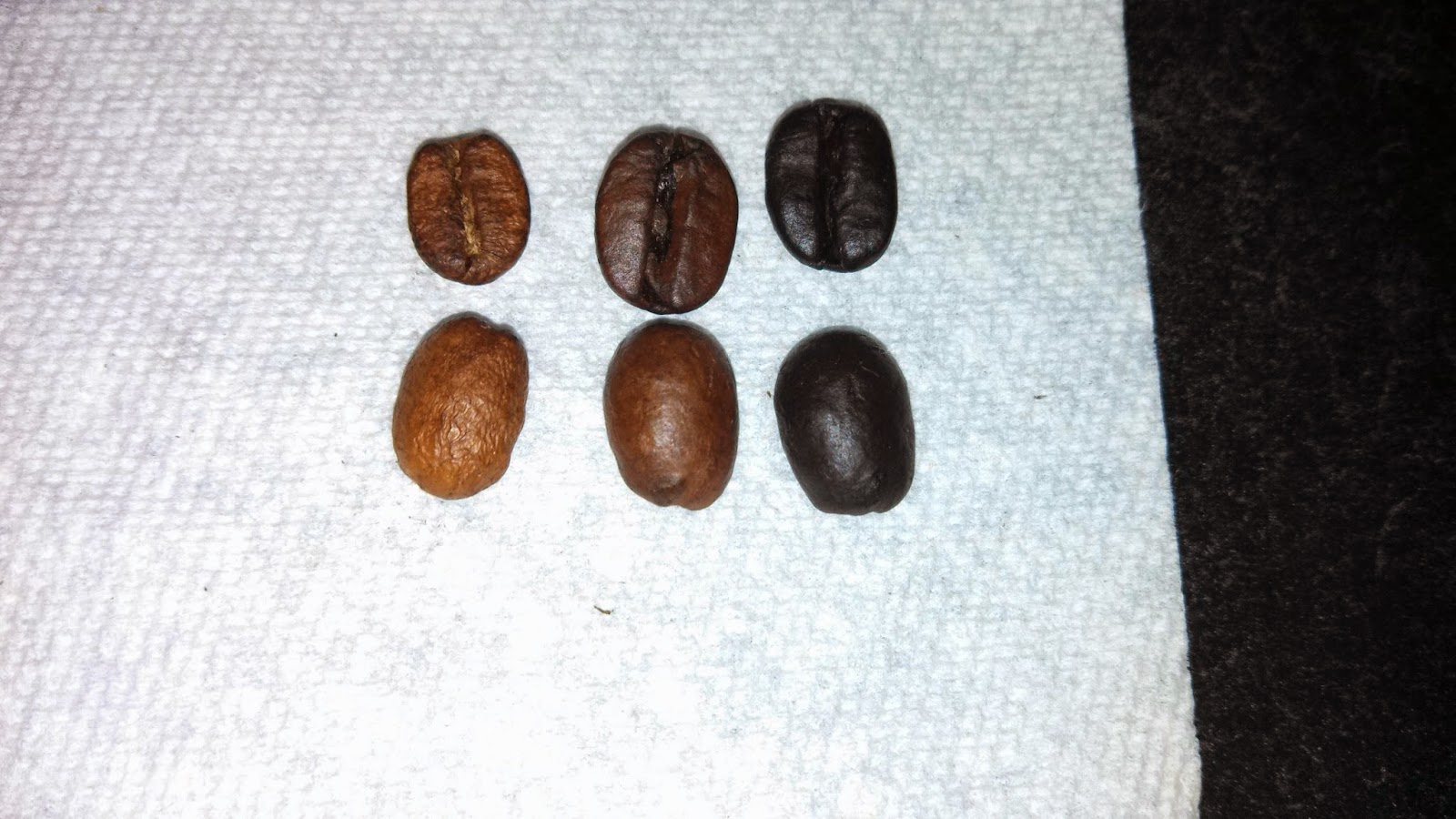
Blend Light Roast, Medium Roast, and Dark Roast Beans to Make Your Custom Coffee Blend
Image Source: Dr. Penny Pincher

Some people like to blend other flavors into their coffee grounds, such as chickory to make New Orleans style coffee.  My sister-in-law likes flavors like hazelnut flavored coffee.  Flavored coffee has flavoring added into the grounds or beans.  To me, flavored coffee tastes like chemicals and is hard to drink at all.  I once gave her a perfectly good bag of expensive coffee grounds because they were butterscotch flavored and I didn't notice this when I bought it.

I blend different coffee beans together sometimes, usually when I only have a few coffee beans left in a bag.  I have made some really good tasting blends.  My favorites are mostly medium roast with some dark roast beans mixed in.

Another popular blend is to mix regular coffee with decaf coffee.  A mix of half regular coffee and half decaf is known as "half caff" coffee.


Blend Coffee Beans or Coffee Grounds to Make a Custom Coffee Blend
Image Source: Dr. Penny Pincher


Recommended Reading
Here is my article on coffee terms- learn more about coffee terms such as Cafe Americano.

Learn about coffee alternatives and coffee substitutes that have less caffeine than coffee.  There are many options for low caffeine or caffeine free coffee beyond decaf or half-caff!

Copyright © 2014 by Dr. Penny Pincher.  All Rights Reserved. Coffee Maker Journal

Sabtu, 25 Januari 2014

Why Does Decaf Coffee Taste Bad?

Why Does Decaf Coffee Taste Bad?

Decaf Coffee- It Doesn't Taste As Good As Regular Coffee!
Image Source: Dr. Penny Pincher


I guess saying that decaf coffee tastes bad is a bit of an overstatement.  I would say decaf coffee is drinkable, but it is not as good as regular coffee.

If you believe the decaf coffee advertising material, you would think decaf should taste like regular coffee.  But it doesn't.  The green coffee beans must be processed to remove most of the caffeine.  This is a very invasive process and changes the flavor- and not for the better.

What Does Decaffeinated Coffee Taste Like?

I drink one 16 oz cup of regular coffee brewed from fresh ground coffee beans every morning, and then switch to decaf.  I drink several cups of decaf every day.  Usually a couple of Keurig k-cups of decaf varieties such as Dark Magic, Tully's, Newman's Own or Donut Shop.  It is not fair to compare coffee brewed from fresh ground beans with Keurig coffee- fresh ground beans make better coffee.  It is also not fair to compare regular coffee to decaf coffee- regular coffee tastes better.

Keurig k-cup decaf coffee
Image Source: Dr. Penny Pincher


I also buy ground decaf coffee or whole bean decaf coffee to brew at home.  This makes for a fairer comparison between regular and decaf coffee.  Regular coffee tastes better, even comparing similar roasts and coffee preparation methods.  Regular coffee has a richer, fuller flavor.  Decaf has more of a burned flavor and is missing some of the complex flavor of regular coffee.  It's sort of like the difference between listening to music in stereo, and then listening to the same song in mono.  Both sound similar, but the one in stereo is much more satisfying.  Why does regular coffee taste better since you can't taste caffeine?

Why Does Decaf Coffee Have Less Flavor?

The process of removing caffeine also impacts the flavor of coffee.  When coffee is decaffeinated, green coffee beans are processed to extract most of the caffeine.  In the old days, chemical solvents were used.  Some of these solvents were toxic and these are not commonly used anymore.  The two common methods of coffee decaffeination today are:

  • Water Extraction: Hot water is used to extract caffeine, but also extracts flavor compounds.  Water containing flavor compounds is used to try to replace the flavor in the "Swiss Water Process".
  • Supercritical Fluid CO2 Extraction: Carbon Dioxide is used at controlled temperature and pressure to penetrate the green coffee beans and dissolve the caffeine so that it can be extracted.
I think the flavor of decaf coffee is negatively impacted by the processing needed to remove most of the caffeine.  There is potential for a variety of coffee trees to be grown that produce decaf coffee beans with no processing required to remove caffeine.  This could be accomplished through finding coffee plants with a natural mutation, or through genetically modified coffee plants that have the chemical pathway to produce caffeine disrupted.

Wouldn't It Be Great If You Could Grow Decaf Coffee?
Image Source: Dr. Penny Pincher

How to Get the Best Decaf Coffee Possible

Given the shortcomings of decaf coffee due to the processing required to remove most of the caffeine, what can you do to get the best possible cup of decaf?  Follow the same principles that are used to make a great cup of regular coffee:


Copyright © 2014 by Dr. Penny Pincher.  All Rights Reserved. Coffee Maker Journal

Rabu, 22 Januari 2014

No More Coffee Beans at Walmart!?

No More Coffee Beans at Walmart?

No More Coffee Beans at Walmart?
Image Source: Dr. Penny Pincher

My wife buys my coffee beans for me when she buys groceries most of the time.  She know my favorite kinds.  I like dark roast Starbucks from Walmart or City Kid from Target.  I have made coffee from whole beans for over 15 years now, and am on my 3rd coffee grinder.  Grinding fresh coffee beans just before brewing means you'll get a fresh cup of coffee with great coffee flavor.

I came home from work to learn from my wife that Walmart did not have and coffee beans for sale.  They had removed their bulk dispensers and did not have any prepackaged whole beans either.  What's up with that!

Is Keurig Replacing Whole Beans?

Are Keurig k-cups replacing whole coffee beans?
Image Source: Dr. Penny Pincher

My first thought is the Keurig k-cups may be replacing whole coffee beans.  There is more profit to be made selling k-cups than selling whole beans.  If you figure out how much ground coffee is in a k-cup and how much it sells for, you'll see the opportunity for profit.  It takes a lot of shelf space to offer lots of different kinds of coffee beans, and the bulk coffee bean dispensers also take a lot of room.  Walmart must have concluded that they could make more money from that shelf space by selling something else.

Do People Have Time for Great Coffee Anymore?

Consumer demand must also be a factor in Walmart's move to stop selling whole coffee beans.  Walmart must not be concerned that people will shop elsewhere to be able to buy whole coffee beans.  This is probably a reasonable conclusion.  The grocery bill is significantly lower at Walmart, so the hassle of picking up coffee beans at another store is not that big of a deal.

Do people have time for great coffee anymore?
Image Source: Dr. Penny Pincher

Perhaps not that many people grind coffee beans at home these days.  There is a Keurig machine at my office, and it is very convenient.  I would say the coffee quality is good, but not great.  Keurig coffee is a step below what I can make at home from fresh ground beans, or what you can get in a coffee shop.  But convenience is important to most people:

  • You can just pop a k-cup in your Keurig and get coffee in about 1 minute
  • You can try different roasts and flavors easily
  • You never have to see or touch a used coffee filter
  • There are no coffee grounds to store, measure, clean-up, etc.

There are certainly advantages to Keurig, but I'm staying with my coffee beans.  Here's how I use whole coffee beans to make great coffee at home every day.

Update:  I checked Walmart today and found that they have a small set of coffee bean dispensers (9 varieties) and a few bags of whole coffee beans available.  So you can find coffee beans at Walmart just not much selection.  Times are changing in the coffee world.  I will shop where I can get whole beans or order online!  It is surprising that whole bean coffee is not popular enough to merit much shelf space.

Walmart has only a few whole bean coffee choices
Image source: Dr. Penny Pincher


Copyright © 2014 by Dr. Penny Pincher.  All Rights Reserved. Coffee Maker Journal

Minggu, 10 November 2013

K Cup Coffee

What is K Cup Coffee?

What is K Cup Coffee?
Image Source: Dr. Penny Pincher


K Cup coffee is coffee made using a Keurig brewing machine.  Keurig brewing machines use coffee pods that contain ground coffee.  The first generation of Keurig machines use coffee pods called K-Cups.


A K Cup Coffee Pod is used to brew K Cup Coffee
Image Source: Dr. Penny Pincher


A K-Cup is a type of coffee pod filled with ground coffee and a paper coffee filter.  The K-Cup is a small plastic cup that is sealed with an air-tight lid to maintain freshness.

How Do You Make K Cup Coffee?

You need a Keurig coffee brewer and a K-cup to make K Cup coffee.  K Cup coffee is easy to make:

  • Place an empty cup under the Keurig brewer 
  • Open the Keurig K-Cup compartment
  • Place the K-cup inside
  • Close the K-Cup compartment lid on the Keurig brewer
  • Press  the "brew" button

In about one minute, you'll have a hot, fresh cup of K Cup coffee.

Keurig brewers use K-Cups to make K Cup Coffee
Image Source: Dr. Penny Pincher

Where Can I Get K Cup Coffee?

K Cup coffee is not sold in restaurants of coffee shops.  Keurig brewers that make K Cup coffee are used in homes and offices.  If you want to try K Cup coffee, but do not have a Keurig brewer, you might be able to find one in a break room at work.  Another option is to see if any of your friends have a Keurig brewer at home.  Most people with a Keurig brewer are excited to show people their machine and let them experience K Cup coffee.


How Much Does K Cup Coffee Cost?

The Keurig coffee brewing machine costs about $75 to a few hundred dollars, depending on the model and features of the coffee maker.  Some Keurig machines use K-Cups and some use Vue coffee pods.  The first generation machines use K-Cups: you'll need a Keurig machine that takes K-Cups to make K Cup coffee.

Once you have a Keurig brewer, you need a K-Cup for every cup of coffee you brew.  K-Cups cost about 65 cents each for premium brands and about 50 cents each if you know how to find cheap K-Cups.

You can also get refillable K-Cups that you fill with your own ground coffee that cost much less than buying K-Cups.  However, one of the main advantages of K Cup coffee is the convenience of being able to quickly pop in your favorite coffee flavor and brand, quickly brew the coffee, and throw the K-Cup away with no clean-up required.  If you use refillable K-Cups, you need to take time to load the refillable K-Cup and also need time to wash and clean the refillable K-Cup for the next cup of coffee.

What Does K Cup Coffee Taste Like?

K Cup coffee is always hot and fresh since it is made one cup at a time.  K Cup coffee is popular in break areas at work for coffee breaks because everyone gets a fresh cup of coffee.  A regular coffee maker leaves coffee sitting in the pot and it gets stale quickly.

You can choose your flavor of K Cup coffee.  You can get light roast, medium roast, dark roast, decaf, and flavored coffee.  You can also get K-Cups to make other hot beverages with your Keurig brewer like hot tea and hot chocolate.

How Does K Cup Coffee Compare to Regular Coffee?

You can make a better cup of coffee than K cup coffee.  Fresh ground whole coffee beans taste better than ground coffee.  I would say the flavor of K Cup coffee is similar to coffee you can make using ground coffee that is not fresh ground from whole beans.

K Cup coffee is definitely faster and more convenient than regular coffee.  Since you heat water for only one cup of coffee at a time, K Cup coffee is very fast.  Almost no clean-up is required for K Cup coffee- just throw the used K-Cup away after brewing and you are ready to make the next cup.

It is really easy to try different flavors and brands of coffee with K Cup coffee.  You can buy assortments of K-Cups to make it easy to try new kinds or to find something that anyone in your home or office would like.


Copyright © 2013 by Dr. Penny Pincher.  All Rights Reserved. Coffee Maker Journal

Minggu, 15 September 2013

How Many Calories are in Coffee?

Does Coffee Have Calories?


How many calories are in a cup of coffee?
Image Courtesy of Julius Schorzman-CC-SA-20


One reason I started drinking coffee is that it is a low calorie beverage.  A 16oz cup of milk has about 250 calories, and a 16oz soda has about 180 calories.  A big cup of coffee lots of flavor and zero calories- or so I thought...

Many years later, I saw a sign at a cafeteria with nutritional facts about a cup of coffee.  I was surprised to see a number listed for calories.  Does black coffee really contain calories?

How Many Calories are in Black Coffee?


The bad news: Yes, even plain brewed black coffee with nothing added does contain some calories.
The good news: Coffee contains only 1 calorie per 8 oz of coffee.  This is almost zero calories.

How can coffee contain calories?  Hot water absorbs flavors and compounds from coffee grounds to become coffee.  These compounds become suspended in the water.  If you evaporate all of the water in a cup of coffee, you are left with a small amount of solid compounds.  If you burn these solid compounds that are contained in coffee in a calorimeter, you will find that the amount of energy contained in a cup of coffee is 1 calorie per 8 ounces.  Your body can convert this material into a small amount of energy, and therefore coffee does contain a small amount of calories.

Brewed black coffee contains almost zero calories.  If you drink your coffee black, you can basically ignore calories from coffee because it contains so few calories.  But many people don't drink their coffee black.

How Many Calories Does Coffee with Cream and Sugar Contain?

As soon as you start adding things to your coffee, you start to add calories and fat.

Of course you can add artificial sweeteners that have almost zero calories.  Popular artificial sweeteners for coffee include:

  • Sucralose-based Splenda 
  • Aspartame-based NutraSweet, Equal, Spoonful, and Equal-Measure
  • Saccharine-based Sweet'N-Low
  • Stevia-based Truvia
Zero calorie sweeteners: Splenda- yellow packet, Equal- blue packet, and Sweet 'N Low- pink packet.  Sugar at 50 calories per tablespoon is in the white packet.
Image Source: Dr. Penny Pincher

All of these artificial sweeteners have much lower calories than sugar.  However, I don't really like the idea of consuming artificial chemicals with my coffee.  One thing I like about coffee is that it is completely natural- just roasted coffee beans and water.

If you add natural sweeteners such as sugar or honey or creamer such as milk, cream, or coffee creamer you start to add a lot of calories and even fat to your coffee.  For example, adding 1 tablespoon of sugar adds 50 calories to a cup of coffee.  If you have a big cup of coffee or drink multiple cups of coffee with sugar throughout the day, you could be adding hundreds of calories per day to your diet.

As far as milk and creamer, a tablespoon of heavy whipping cream adds 50 calories plus 5g of fat.  Half and half adds 20 calories and 1.8g of fat per tablespoon, and skim milk only 5 calories and no fat.  Coffee-mate coffee creamer has 20 calories and 1g of fat per tablespoon.  If you can switch from cream to skim milk, you can make your coffee contain much fewer calories.  Many coffee drinks contain much more than one tablespoon of cream, so coffee drinks such as lattes and cappuccinos are actually high in fat and calories.

Half and Half coffee creamer has 50 calories and 5 grams of fat per tablespoon
Image Source: Dr. Penny Pincher

The table below shows the calorie content for black coffee and for coffee with sugar, coffee with cream and sugar, and coffee with spenda and skim milk:

Black coffee:
16oz: 2 calories

Coffee with spenda and skim milk:
16oz with 2 tablespoons of splenda and 2 tablespoons of skim milk: 12 calories

Coffee with sugar:
16oz with 2 tablespoons of sugar: 102 calories

Coffee with cream and sugar:
16oz with 2 tablespoons of sugar and 2 tablespoons of cream: 202 calories

If you are watching calories, try to switch to black coffee or at least switch from cream to skim milk if you are adding creamer.  I like to add honey as a sweetener rather than sugar.  I think the calories are similar, but for me honey has a complementary flavor to coffee.

Copyright © 2013 by Dr. Penny Pincher.  All Rights Reserved. Coffee Maker Journal

Minggu, 11 Agustus 2013

How to Quit Caffeine or Reduce your Caffeine Intake


How much caffeine are you getting?

I was surprised to learn how much caffeine I was getting every day.  I was drinking two 16 ounce cups of strong coffee brewed from fresh ground coffee beans.  From this caffeine table, I learned I was getting about 400 milligrams (mg) per cup, a total of 800 mg of caffeine every morning.  That is a lot of caffeine!  For reference, a Five Hour Energy has 200 mg of caffeine and a 20 oz Mountain Dew has 90 mg of caffeine.


Caffeine molecule
Should you quit caffeine or reduce caffeine consumption?
Image by Icey, ClockworkSoul- Public Domain


As they say, caffeine is slightly habit forming.  I didn't feel right if I didn't get my 2 big cups of coffee promptly each morning.  I decided to reduce my caffeine intake to a more manageable level.

How much caffeine is too much?

Caffeine affects individuals in different ways- some people metabolize caffeine more rapidly and can tolerate higher levels of caffeine better.  For me, I would say 800 milligrams a day was too much.  One issue was the logistics of getting that much caffeine.  I would brew and carry two cups of coffee with me.  Sometimes I would need to stop to use a restroom on drive to work.  When travelling it was sometimes not possible to get that much coffee before the day started.  Once when visiting my brother, who is not a coffee drinker, I was climbing the walls until he took me to Einstein Brothers for a couple cups of coffee.  He was pretty amused by how badly I wanted some coffee.

Health effects of caffeine is a complex issue.  From what I understand, your blood pressure does increase for a short time, for example one week, when you first start taking in caffeine- but then your blood pressure stabilizes and is no longer elevated after that.  I have also seen reports that drinking a small amount of coffee every day makes your blood vessels more flexible and actually reduces blood pressure.  But please check out health effects of caffeine for yourself- I am not a doctor.  Well, actually I am a doctor, but not that kind.

Another health effect of caffeine is sleep disruption.  This was not really a problem for me since all of my caffeine consumption was in the morning.  The half life of caffeine in the human body is approximately 8 hours, so by evening most of the caffeine from your morning coffee has been metabolized and is not going to keep you awake or disrupt your sleep.  However some people drink coffee in the afternoon, and even at night.  This is almost certain to cause sleep disruption which can have a range of negative health effects.

Caffeine in high doses can cause headaches and jumpiness.  I did experience a caffeine headache from too much caffeine once and it was not pleasant.  You can also get headaches from caffeine withdrawal- if you are not able to get your morning coffee, you may get a headache and generally feel crummy.  I also experienced this type of headache many times when my caffeine supply was disrupted for various reasons.

Cutting your caffeine intake can save you money.  If you don't "need" several cups of coffee each day, you can certainly reduce your coffee spending.  If you don't require as much caffeine to get through the day, you can choose lower cost or free beverages instead of springing for highly caffeinated coffee which goes for over $2 per cup at coffee shops.

How to reduce caffeine intake and still enjoy great coffee

So, you've decided to cut back on caffeine or even quit caffeine.  How can you reduce your caffeine intake, avoid headaches and withdrawal symptoms, and still enjoy great coffee?  You want to slowly reduce your caffeine intake, avoiding sudden changes.  I tried suddenly cutting my caffeine intake in half and this caused headaches and I felt grumpy and couldn't concentrate.  After going back to my full level of caffeine, I slowly stepped down my caffeine level over a two week period.  I was able to adjust easily to this rate of change.

There are methods to gradually reduce your caffeine intake:
Method 1:  You can just cut back on the amount of coffee grounds you use each day- and cut back on the water by the corresponding amount to gradually reduce your caffeine consumption.

Method 2: Another approach is to mix decaf coffee grounds with your regular coffee grounds, gradually increasing the ratio of decaf to regular.  This method has the advantage that you still get your normal amount of coffee all the time, which can be easier to deal with than having less coffee each day.

There are a number of coffee substitutes such as chickory, carob root, Teccino, Pero, Postum, and others that have little or no caffeine.  These can be mixed with coffee grounds, or used to replace a second cup of regular coffee.  Also hot tea (either black tea or green tea) has much less caffeine than coffee- try to substitute tea for some of your coffees.

Method 3:  Set a strict cut-off time for caffeinated coffee.  For example no coffee (except decaf) after 10am or noon, etc.  This will help you reduce or avoid sleep problems, and can help you lower your overall caffeine intake.

You may find the best approach for you is to use a combination of all of these methods to gradually reduce your caffeine intake.  If you cut caffeine too quickly, you will have withdrawal symptoms and are likely to resume your previous high level of caffeine intake to relieve your symptoms.

My goal was to cut back to a single 16 ounce of regular coffee per day, which I reached after 2 weeks of gradually reducing caffeine intake.  This seems like a manageable and moderate level of caffeine intake, and I focus on making one great cup of regular fully-caffeinated coffee every morning.  After that I switch to decaf coffee, decaf black tea, and green tea.

If you decide to go further in reducing your caffeine intake, how do you completely quit caffeine?


Quit Caffeine

The approach to quit caffeine is the same for reducing caffeine intake- keep reducing your caffeine intake gradually each day.  If you want to quit caffeine, you'll need to keep going until you are drinking only decaf or coffee substitutes.  To really quit caffeine completely, you'll need to watch out for caffeine from sources other than coffee such as soda, tea, and chocolate.

I think enjoying coffee in moderation is good for you.  As with most things, too much of even a good thing can have consequences.  It is worth considering how much caffeine is the maximum you want each day, allowing you to enjoy some coffee without negative consequences of too much caffeine.


Copyright © 2013 by Dr. Penny Pincher.  All Rights Reserved. Coffee Maker Journal